

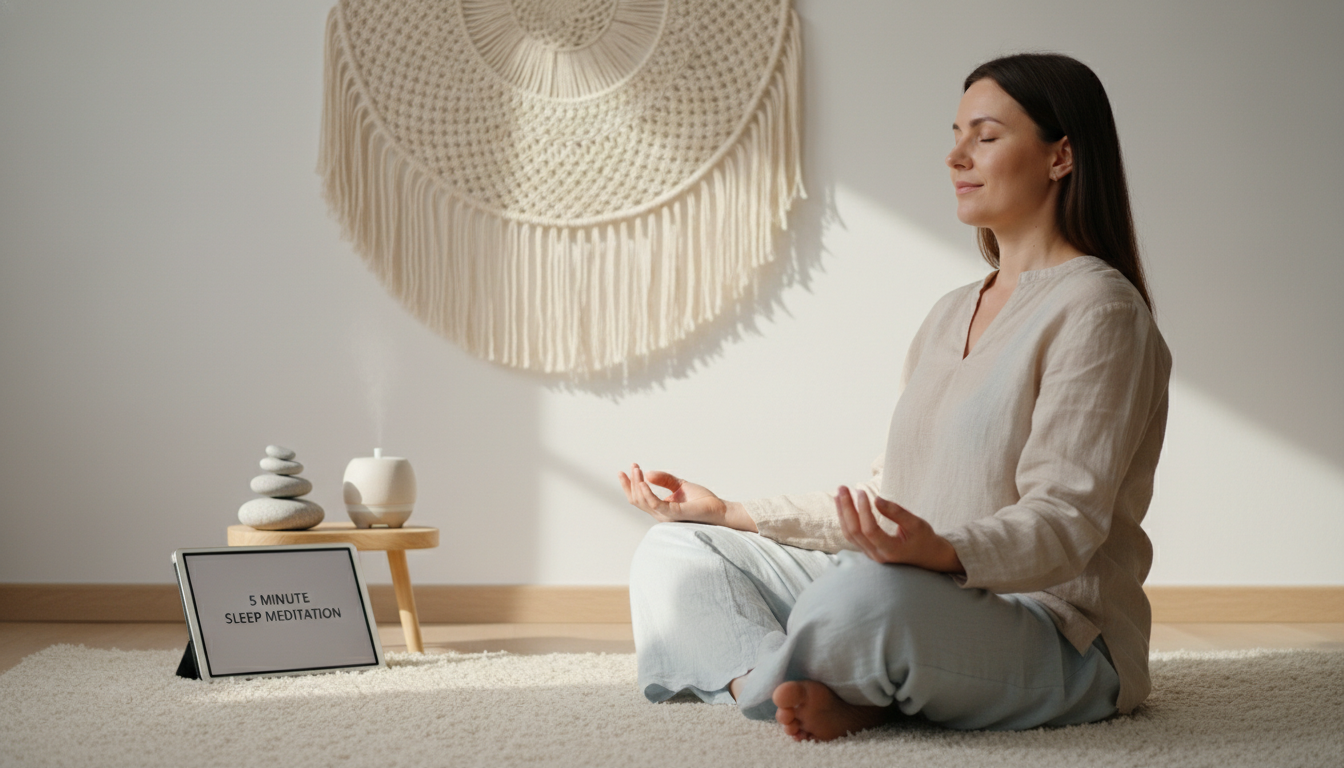
5 Minute Sleep Meditation: Your Guide to Falling Asleep Fast
It is a familiar struggle for millions of people. You lay in bed, exhausted from a long day, desperate for rest. Yet, the moment your head hits the pillow, your mind begins to race. You replay conversations, worry about tomorrow’s to-do list, or simply stare at the ceiling, watching the clock tick minutes away from your sleep time. This is where a 5 minute sleep meditation can be a life-changing tool.
Many people believe that meditation requires sitting in silence for an hour or achieving a state of complete thoughtlessness. This misconception keeps many from trying it. In reality, short, focused bursts of mindfulness—specifically designed for sleep—are incredibly effective at switching the nervous system from “fight or flight” to “rest and digest.”
This guide will explore why five minutes is often all you need, provide you with actionable techniques, and offer a guided script you can use tonight to drift off into deep, restorative slumber.
Can You Really Fall Asleep in Just 5 Minutes?
The short answer is yes, or at least, you can set the stage for sleep within that timeframe. The goal of a 5 minute sleep meditation is not necessarily to be unconscious the moment the timer hits zero, but to lower your heart rate, slow your breathing, and quiet the cortisol spikes that keep you awake.
When you are stressed or overstimulated, your sympathetic nervous system is active. This is the body’s alert mode. To sleep, you must activate the parasympathetic nervous system. Short meditation techniques act as a biological switch. By focusing on your breath or a specific visualization for just 300 seconds, you signal to your brain that you are safe, allowing the production of melatonin to take over.
Consistency matters more than duration. A nightly 5 minute routine signals to the brain that the day is over, creating a Pavlovian response that induces drowsiness almost immediately.
Top 3 Techniques for a 5 Minute Sleep Meditation
If you do not have a guided audio track handy, you can use these three simple, highly effective methods. They require no equipment and can be done lying in bed.
1. The 4-7-8 Breathing Method
Developed by Dr. Andrew Weil, this technique is a natural tranquilizer for the nervous system. It forces you to focus on counting, which interrupts racing thoughts, while the breath holding aspect allows oxygen to fill your lungs and circulate through the body.
– Exhale completely through your mouth, making a whoosh sound.
– Close your mouth and inhale quietly through your nose to a count of 4.
– Hold your breath for a count of 7.
– Exhale completely through your mouth, making a whoosh sound to a count of 8.
– Repeat this cycle for four breaths. By the time you finish, your heart rate will likely have slowed significantly.
2. The Body Scan (Progressive Muscle Relaxation)
We often hold tension in our bodies without realizing it. You might be clenching your jaw or shrugging your shoulders while trying to sleep. The body scan brings awareness to these areas.
– Start at your toes. Curl them tight for five seconds, then release.
– Move to your calves. Tense them, then release.
– Work your way up through your thighs, buttocks, stomach, hands, shoulders, and face.
– Focus intently on the sensation of the muscle relaxing. This physical release often triggers a mental release.
3. Cognitive Shuffling
This is a technique used to distract the brain from analytical thinking. The brain cannot focus on random imagery and stressful thoughts at the same time.
– Pick a word, for example, “BEDTIME.”
– For each letter, visualize a word starting with that letter. For “B,” visualize a Bear, a Ball, a Boat.
– Visualize the object clearly for a few seconds.
– If you run out of words for a letter, move to the next one.
– This mimics the random, fragmented thoughts that occur naturally just before sleep onset.
A Guided 5 Minute Sleep Meditation Script
If you prefer to read this to yourself or record it to play back, use this script. Read it slowly, pausing where indicated.
The Script: Drifting into the Clouds
Start by finding a comfortable position. Adjust your pillows. Pull the blankets up to your chin. Close your eyes. Take a deep breath in… and let a long, slow breath out. Allow your day to fade away. There is nowhere else you need to be. There is nothing else you need to do.
(Pause for 10 seconds)
Bring your attention to the top of your head. Imagine a warm, soft light touching your scalp. This light is heavy and relaxing. Feel it move down over your forehead, smoothing out any worry lines. Let it move over your eyes, allowing them to rest heavy in their sockets.
Let the warmth travel down your cheeks and into your jaw. Unclench your teeth. Let your tongue fall away from the roof of your mouth. Your face is completely soft.
(Pause for 10 seconds)
Now, visualize that you are lying on a soft, fluffy white cloud. It is supporting your entire body. You are safe here. As you breathe in, the cloud rises gently. As you breathe out, the cloud sinks down, rocking you slowly.
In… rising up.
Out… sinking down.
Feel the weight of your shoulders sinking into the cloud. Feel your arms becoming heavy. The relaxation flows down your spine, into your hips, and down your legs.
(Pause for 10 seconds)
Your legs feel like dead weight, sinking deeper into the softness. The warmth reaches your toes. You are completely supported. You are warm. You are heavy.
Listen to the sound of your own breath. It is a slow, rhythmic wave. With every exhale, you are letting go of tension. With every exhale, you are drifting deeper into the cloud.
Sleep is coming to you. You do not need to chase it. Just float. Just breathe.
(Long Pause)
Drift. Float. Sleep.
The Benefits of Micro-Meditations for Sleep
Why should you choose a 5 minute sleep meditation over a longer session or medication? There are several compelling reasons why this approach is superior for long-term health.
Reduces Anxiety and Rumination
Insomnia is frequently caused by rumination—the loop of negative thoughts. Meditation breaks this loop. By giving the brain a focal point (the breath or a visualization), you starve the anxiety of the attention it needs to thrive. Even five minutes is enough to break the cycle.
Improves Sleep Quality
Falling asleep is one thing; staying asleep is another. Studies suggest that mindfulness practices can increase the duration of Deep Sleep and REM cycles. These are the restorative stages of sleep where the body repairs tissue and the brain processes memories. Entering sleep in a relaxed state, rather than an exhausted crash, often leads to fewer awakenings during the night.
No Side Effects
Sleep aids and melatonin supplements can cause grogginess the next morning, known as the “sleep hangover.” Meditation uses your body’s internal chemistry to induce sleep, meaning you wake up feeling clearer and more refreshed.
Accessibility
You do not need a subscription, a pill, or a special pillow. You can perform a 5 minute sleep meditation in a hotel room, on a plane, or in your own bed. It is a tool that is always available to you.
Preparing Your Environment for Success
To get the most out of your 5 minute sleep meditation, your environment should support relaxation. Even the best meditation script cannot overcome a room that is too bright or too loud.
– Eliminate Blue Light: Turn off screens at least 30 minutes before bed. If you use your phone for a guided meditation app, ensure the screen is dimmed or face down. The blue light from screens suppresses melatonin production.
– Cool the Room: The ideal temperature for sleep is around 65 degrees Fahrenheit (18 degrees Celsius). A cooler room mimics the body’s natural temperature drop during sleep.
– White Noise: If you live in a noisy area, use a fan or a white noise machine to mask sudden sounds that might jolt you out of your meditative state.
– Aromatherapy: Scents like lavender and chamomile have been proven to lower heart rate. A quick spray on your pillow before you start your meditation can enhance the effect.
Frequently Asked Questions About Sleep Meditation
What if I still can’t fall asleep after 5 minutes?
Do not panic. The goal is relaxation, not forcing sleep. If you finish the meditation and are still awake, simply repeat the cycle or just enjoy the feeling of your body being relaxed. The anxiety of “I must sleep now” is often what keeps you awake. Let go of the outcome.
Is it better to sit up or lie down?
For general mindfulness, sitting is recommended to stay alert. However, for sleep meditation, you should lie down in your preferred sleeping position. The goal is to drift off, so you want to be ready for sleep immediately.
Can I do this every night?
Absolutely. In fact, it works better the more you do it. Your brain will begin to associate the specific breathing pattern or visualization with sleep, making the process faster and more effective over time.
Should I use headphones?
If you are listening to a guided track, headphones can be helpful to block out external noise and create an immersive experience. However, ensure they are comfortable enough to sleep in, or use a speaker next to your bed so you don’t get tangled in wires.
Conclusion
Sleep should not be a battleground. By incorporating a simple 5 minute sleep meditation into your nightly routine, you are giving your body the permission it needs to shut down. Whether you choose the 4-7-8 breathing technique, a body scan, or a visualization, the result is the same: a quieter mind, a relaxed body, and the deep rest you deserve. Try it tonight, and experience the power of a mindful transition into sleep.
